The Cannabis Library Cannabis Activism Cannabis Culture Cannabis Politics and Law Medical Uses of Cannabis Industrial uses for cannabis and hemp Search the UKCIA site Contact UKCIA
Home
Industrial potential of hemp

Features on hemp

The Agriculture of British Hemp in the 1990s
by Peter Messenger and Ian Low from Hemcore. In this major report, pioneering hempsters Hemcore outline how they persuaded the Home Office to let them grow hemp, and all the details of hemp cultivation in the UK in the 90's.

Hemp Textiles in Britain - Opportunities for Bioregional Development
by Sue Riddlestone from the Ecology Center, in Essex. In this paper presented to the Industrial Hemp Conference in Canada in March 1996, the concept of sustainable bioregional development is outlined and the prospects for growing hemp for textiles in the South-east of England are discussed.

The Agricultural History of Hemp in the UK
by Stuart Young (From the Culture section)
In this work-in-progress, you can discover where and why hemp was grown in the UK in the past 1000 years. Also what sort of evidence is there that hemp was grown?

Helping Earth's Sustainable Management with a Plant
kindly donated to UKCIA by the author, Clare Saunders, upon finishing her degree.

Ecolution
This commercial website features pictures of hemp growing, being harvested and processed. They offer a wide range of hemp products and also have an extensive guide to hemp information on the Internet.

Archive of hemp reports
Hemp's ability to choke out weeds.
By Dr Dave West

UK Flax and Hemp Production - The impact of changes in support measures on the competitiveness and future potential of UK fiber production and use. DEFRA website - PDF format.

Hemp Global Solutions
Formed by a group of people who share a common vision for hemp, as a potential solution to some of the major social and environmental challenges of the 21st century.

Hemcore
The largest grower and processor of hemp inthe UK

field of Hemp in the UK

A field of Hemp, somewhere in England

In this section we hope to outline the possible industrial uses of hemp; to summarise the state of the hemp industry world-wide and in the UK; to review hemp products and services; and to show how hemp (along with other plants, and an investment in new technology) could help us move to a sustainable economy future for the planet.

This section also includes a copy of a presentation on hemp textiles from the Industrial Hemp Conference in Canada (March 1996) by UK researchers from the Ecology Center, Essex, England.

Can Hemp Save The Planet?

In his book, The Emperor Wears No Clothes, Jack Herer states that hemp can save the planet. He says that hemp grows easily anywhere, including marginal land, with little water and no fertilisers or insecticides. He says that hemp, an annual crop, could supply humanity with everything that it needs, and that there is no need to exploit the planets dwindling resources. Herer offered $10000 to anyone who could disprove this, and eventually his ideas crossed over to the mainstream press. The Emperor is now a bestseller in English, French and German, and a British edition was published in 1994.

Another book published in 1994 was Hemp Today, edited by Ed Rosenthal. This book summarises the state of the global hemp industry in the early nineties, outlines the many potential uses of hemp, and asks whether Herer is right. Hemp Today concludes that hemp is no magic bullet, and will not save the planet on its own. However if there is investment in new technology, and a social and political revolution, then hemp and other annual plants will play a major role in a sustainable future for the planet.

According to Hemp Today, there are a number of flaws in Herer's argument. Firstly, hemp does require fertilisers and lots of water, to achieve maximum growth rates, so that it can compete economically with current practices. However hemp does do well in rotation with other crops and if fertiliser is supplied then it can be grown for at least 50 years on the same soil with no drop in yield. There may be few pests that effect hemp in the US, but in other countries insecticides are needed.

One of the main problems facing the hemp industry is that the main consumer demand, entrepreneurial spirit, technological research and source of finance are all in the US, where it is illegal to grow all hemp, even if it contains little or no THC. Many of the processes suggested for hemp will only be economic if the transport costs are minimised by building the factory close to the fields. Thus there must be legal growth of hemp in the US before anyone will invest money in new technology.

Paper from Hemp

Until the close of the 19th century, all the world's paper was made by recycling worn-out cloth such as sails, sheets, clothes and rags. These were mainly made from hemp (but also flax) so that Herer claims that 75-90 % of paper was made from hemp. With the Industrial Revolution the demand for paper exceeded the availiable rag supply, and inventors began to develop new processes to make paper from natural resources. Unfortunately the largest profits were made by exploiting the worlds forests. A hundred years later we have cleared almost all the primary forest in Europe and North America. Now we must use a sustainable resource for our paper, either managed forests or an annual plant.

Hemp produces paper of a far higher quality than trees. Throughout the 20th century speciality papers were made from hemp. These include most cigarette papers, scientific filter papers, coffee filter papers, tea bags, art papers etc. Currently only 0.05% of the world's paper is made from hemp.

According to Herer, 3-4 times more paper can be produced from hemp than from trees. Pulp made from trees must be bleached using environmentally destructive processes, such as chlorine-bleaching. Hemp pulp can be bleached with relatively harmless hydrogen peroxide.

Paper can be made from hemp hurds, thus if hemp is grown for fibre or seeds, famers will have an extra product they can sell. However if paper is to made from hemp, it will require massive investments in new technology to process the hemp. Paper-making industries will need to be relocated close to hemp growing areas to minimise transport costs.

The feasibility of paper-production from hemp was recently assessed in a comprehensive three-year Dutch research program involving scientists from 12 institutes and costing Dfl 17 million (£7 million). The Dutch are searching for new crops which can be grown in rotation with their standard crops. They believe that rotating crops will control potato parasites, without needing dangerous pesticides! The researchers found that hemp would be economically viable and developed a detailed business plan.

They recommended that 1000 arable farmers from the north-east of the Netherlands should set up a co-operative, which would own shares in a new pulp factory. Additional funding would be needed from government subsidies and loans. The initial cost would be Dfl 57 million (£22 million) and after 5 years production capacity would be increased making a total investment of Dfl 127 million (£51 million).

However when the plan was put to a committee of farmers, government officials and paper-makers, they decided that some of the assumptions of the business plan were uncertain and that further research, and a pilot plant were needed. This would take a further 2 years and cost Dfl 8-10 million (£4 million). UKCIA are still looking for information on how the project is going.

Food from hemp seeds

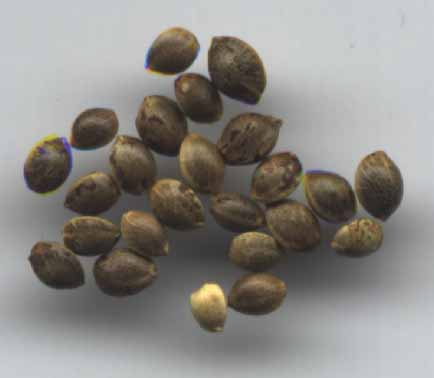
Throughout world history people prized the nutritious and delicious hemp seed as a valuable food resource. Each culture had its own traditional recipies. Typically they would be ground and used like flour, pressed to produce oil or toasted and used in celebratory treats. Today they are still used in cooking in many countries worldwide, while hemp enthuasiasts in the west are developing and marketing new products such as chewy bars, cheese and ice-cream!
Hemp seeds also continue to be used as bird feed. Indeed the testimony of parakeet fanciers that their birds would not sing, unless they were fed hemp seeds convinced the US congress to make an exception in 1937, so long as the seeds were sterilized so that no plants could be grown from them. The seeds contain no THC. Sterilization however lowers the shelf-life of the seed - they can go rancid much quicker.

Hemp seeds have nutritional qualities which make it extremely valuable as a human food. They are high in essential minerals, but low in dangerous heavy metals. They are low in vitamins but you should be getting those from fresh vegetables. They contain a high proportion of protein, containing all eight essential amino acids (needed by, but not made by the human body) in the correct proportions that humans need. Soybeans contain more protein, but these are complex proteins that many people find hard to digest. The proteins in hemp are so easily digestible, that scientists advise their use for treating malnurishment.

Hemp seeds contain large amounts of oil, almost all of it unsaturated. Hemp oil is mainly composed of the essential fatty acids (needed by, but not made by the human body) in exactly the correct proportion that humans need. The supplementary oil industry in the US is just becoming big business, with sales of primrose oil and flax oil rising. These don't contain the right balance of oils, and they taste unpleasant - hemp oil has a delicious nutty taste. However hemp oil has one major drawback - it goes rancid extremely quickly after exposure to air. Vacuum pressing and bottling will keep the oil fresh for up to a year, but after it has been opened it must be kept refrigerated and used very quickly.


Page designed and maintained by UKCIA