New Scientist Marijuana Special Report
New Scientist, Feb 21, 1998
A safe high?
Claim ONE: "Critical skills related to attention, memory and learning are impaired among heavy users of marijuana . . ."
Most people think of marijuana users as dreamers with the attention span of a gnat and no memory worth the name. Wrong. The picture emerging from psychology labs is that there is at most a kernel of truth in this stereotype, while some studies find no evidence of even subtle mental impairment in heavy users. And even those that do are open to a range of interpretations -- not necessarily worrying to marijuana users.
Take the latest findings on which the above claim is based. Harrison Pope and his team at Harvard University compared 65 college students who smoked marijuana daily with a control group of students who smoked it most every other month. After a drug-free day, the subjects completed a range of standard mental tests. Mostly, differences between the two groups were slight. When it came to remembering lists of words, for example, the heavy users recalled about 1 in 10 fewer words than the light users.
But in one test the heavy users underperformed more noticeably. The test involved watching and mimicking the simple rules used by an experimenter to match cards with coloured shapes on them, and then adapting whenever the rule changed. Students who rarely smoked marijuana mistakenly carried on with the old sorting rule on about 5 out of 100 occasions, while heavy users made about 8 mistakes. Pope takes this seriously. "In the real world," he says, "people have to deal all the time with situations in which rules are changing..."
Fine. But over the years, much stronger claims have surfaced: heavy marijuana users do badly at work or school, are more likely to be delinquent and develop psychiatric problems, or have abnormal brain waves. Time and again, however, such studies encounter the same objection: are the problems caused by smoking marijuana, or is it just that people with problems are more likely to end up using marijuana heavily?
In the case of delinquency, schizophrenia and mental illnesses, the balance of the evidence points to the second explanation. Marijuana doesn't cause the problems, although it may make them worse. Some schizophrenics, for example, are drawn to the drug because it eases their sense of alienation. And most researchers now accept that the evidence linking marijuana to abnormal brain waves vanishes when people with psychiatric problems, illnesses or a history of general drug abuse are excluded from studies.
But what about subtler problems like the card sorting deficiencies? After all, it might just be that smart college students tend to smoke lightly while others smoke heavily. In which case the card sorting results may have little to do with marijuana.
Here opinions diverge. Pope believes the deficiency does have something to with marijuana because his team controlled for such obvious things as IQ differences, psychiatric histories and heavy use of other drugs. But others are not convinced. What worries some critics is that in this study, as in others, the women drug users did so much better than the men in most tests.
Deviant
males
"I know of no reason why there should be a gender difference
in cognitive response to cannabis," says John Morgan, a pharmacologist at
the City University of New York Medical School and co-author of a controversial
new book advocating decriminalisation, Marijuana Myths Marijuana Facts. Morgan
believes the reason the males underperform in such studies is that they are "deviant"
in subtle ways that escape the researchers' notice.
And what if the poor test results do turn out to be linked to marijuana? It doesn't automatically follow that heavy marijuana use is causing long-lasting brain damage. One possibility is that, deprived of their favourite drug for a day, heavy users suffer withdrawal symptoms or become so grumpy and distracted that they do badly in tests. Another is that a single drug-free day is not long enough for the effect of their last smoke to have disappeared. The Harvard team's follow-on experiments, in which marijuana users are being tested over a 28-day "dry" period, should provide answers.
Other research suggests that evidence of dramatic mental decline is unlikely to be found, even as a result of long-term heavy use. Over the past 25 years, Jack Fletcher at the University of Texas in Houston and his colleagues have been visiting Costa Rica to test the mental skills of very heavy users. Although some of them have smoked 10 joints a day for more than 30 years, their ability to learn and remember lists of words is only mildly impaired (see diagram below). And even when struggling with more demanding tasks, such as recalling information while pressing a tapper as fast as possible, their scores fall well within the normal range.
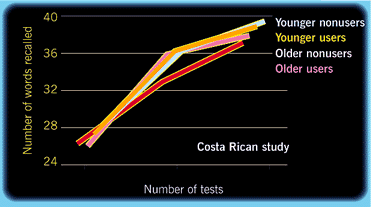
Spot the difference: What cannabis does to memory skills
"The effects are subtle and subclinical," says Brian Page, an anthropologist from the University of Miami, who was involved in the study. "Although they could be bad for somebody who's trying to be an arbitrage trader or Wall Street lawyer." And, Page adds: "People who sell bicycles had better not ride while under the influence."
Or at any rate common sense suggests they should not. The verdict from research into the impact of marijuana on road safety skills is less clear. In Britain as many as 1 in 10 motorists involved in serious accidents test positive for cannabis. And figures as high as 37 per cent have emerged from studies in urban areas of the US. However, many of these drivers also test positive for alcohol, and even the cases involving just cannabis cannot be equated with people driving under the influence because the drug lingers so long in the body.
In driving simulators, marijuana does impair visual skills and mental dexterity. But studies of actual driving show that even high doses of marijuana have less impact than alcohol, perhaps because smoking it doesn't usually make people so reckless. In one study, low doses of marijuana made drivers more cautious.
The same broad message is likely to be true for the subtler, longer-lasting effects of marijuana on the brain. Researchers like Pope and Morgan may look at the data very differently, but they agree about one thing: heavy boozing is worse for your neurons than dope.
From New Scientist, 21 February 1998