New Scientist Marijuana Special Report
New Scientist, Feb 21, 1998
Claim TWO: "More than 120 000 people in the US seek treatment each year for their marijuana addiction . . ."
After years of decline, marijuana use among teenagers is now climbing rapidly in almost every industrialised nation. Will this create a generation of cannabis addicts?
The middle classes who enjoy a smoke once or twice a week may laugh at the idea. But doctors who treat the minority of users who have lost control take it more seriously. The pragmatic question is how big is this minority and would it expand if the drug was decriminalised or even legalised? The experience of the Netherlands (see Vraag een Politeagent) suggests the answer to the second question is "no". The first question is tougher.
At the very least, NIDA's figure of 120 000 cannot be taken seriously. It includes people who are arrested for cannabis offences and then given the chance of going into treatment as an alternative to prosecution, as well as workers who test positive for cannabis in random urine tests and opt for rehabilitation rather than being fired. The figures don't tell us how many people really get hooked.
At Columbia University in New York, addiction epidemiologist Denise Kandel has been taking a different tack. She has been analysing data collected every year in the US National Household Survey on Drug Abuse. And she concludes that subtle symptoms of dependence are more widespread among teenage users than previously thought.
Shocking
statistic
About 15 per cent of teenagers who smoke marijuana report three
or more "symptoms" of dependence from a list of six possible symptoms.
They range from "feeling dependent" or being unable to cut down on consumption
to using ever larger amounts of cannabis to get the same effect. Applying these
same measures to alcohol, it turns out that marijuana is just as addictive as
alcohol for adults and even more so for teenagers (see below). That shocks most
marijuana users, but not Kandel, who believes kids may be unusually "sensitive"
to marijuana for biological as well as social reasons. The way she sees it, the
reason we have so many alcoholics is simply that there are so many people drinking.
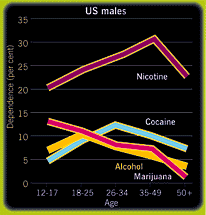
Days of depence: marijuana's addictive powers wane with age
The problem with this kind of research is that it all depends on what is meant by addiction. A drug addict is usually seen as a person liable to both withdrawal symptoms and long-term damage to their health. But Kandel's self-report criteria are based on a broader definition. If we applied them to coffee, vast numbers of us would qualify as addicts. Similarly, many people might describe themselves as "addicted" to shopping or television or chocolate. Kandel's analysis suggests young marijuana smokers are more likely to show symptoms of dependence than their beer-swilling contemporaries, but it doesn't tell us which substance is the more dangerously addictive.
What is clear is that as users enter their 20s, they report this dependence far less frequently. And of the people who are still smoking the drug in their 50s, fewer than one in 30 qualify in her analysis as being dependent. Addiction rates for nicotine follow the opposite trend.
This leads to what is perhaps the most telling statistic about the addictive powers of cannabis: more than 90 per cent of people who have ever used the drug have long since quit. While most people continue drinking and cigarette smoking long after the first flush of youth, people drop the weed in droves after the age of 30.
From New Scientist, 21 February 1998